Blog
NotebookLM Competitive Analysis & Market Research Complete Guide: Turn Public Materials into Verifiable Insights with Source-Grounded AI
A complete guide to competitive analysis and market research with NotebookLM—from aggregating official sites, research reports, and reviews to comparison tables, briefing export, and citation checks—helping you produce evidence-based market insights with Google's AI note-taking tool.
NotebookLM Competitive Analysis & Market Research Complete Guide: Turn Public Materials into Verifiable Insights with Source-Grounded AI
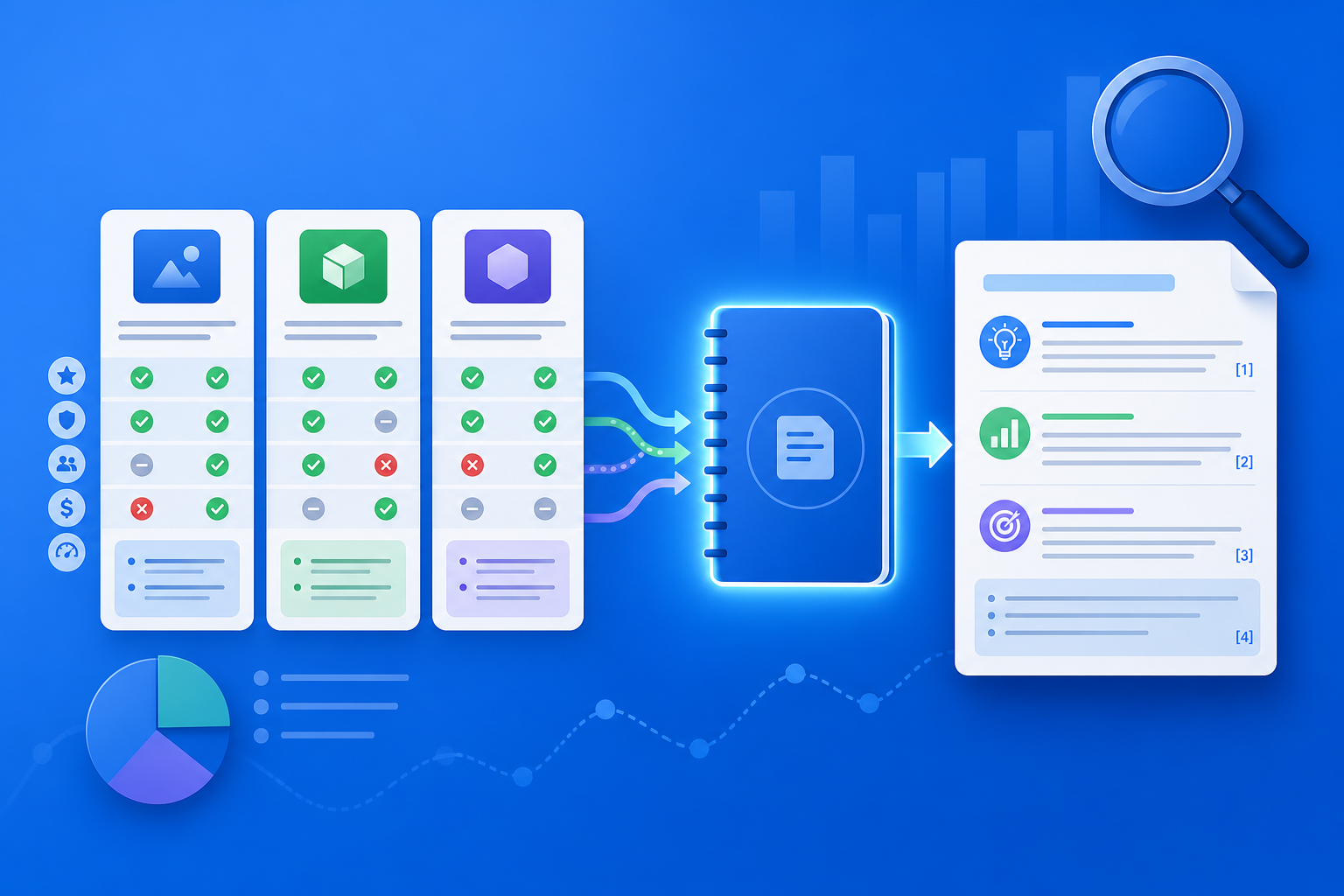
When doing competitive analysis, the most common failure is not “no ideas,” but materials scattered across a dozen tabs: pricing pages, feature comparison articles, App Store reviews, analyst reports, and competitor demo videos. Put these public materials into NotebookLM, and Google’s AI note-taking tool can run source-grounded Q&A on your uploads—feature differences, pricing structures, user pain points, and market narratives all come with clickable citations. Research shifts from “writing conclusions by impression” to “insights with an evidence chain.”
This article systematically covers how to use NotebookLM to build a competitive research notebook, generate comparison tables and briefings, best-fit scenarios, and anti-hallucination tactics—so product, marketing, and strategy teams can embed an AI research assistant into a real market research workflow.
Why Is Competitive Analysis Better with NotebookLM Than Generic AI Alone?
Generic models can fluently write “professionally sounding” competitor paragraphs, yet often mix up features, versions, and prices. NotebookLM’s strengths are:
- Conclusions you can trace: Every key claim has a clickable citation back to the official site, research report, or review original
- Sources you can align: PDFs, web pages, YouTube, and review excerpts for the same competitor live in one notebook
- Structure you can reuse: Comparison tables, Study Guides, mind maps, and briefings can iterate the same question repeatedly
- Boundaries you can declare: Ask it to “state when sources do not mention this,” reducing guesses written as facts
That matters especially for product reviews, sales battle cards, and investment memos you must deliver to bosses or clients.
How Do You Finish an Evidence-Based Competitive Analysis with NotebookLM?
Step 1: Build a research notebook by “category / competitor set”
- Sign in to the NotebookLM app
- Create a notebook per project (e.g., “2026 Q3 smart notes category competitors”) and only collect sources relevant to this research round
- Upload competitor official feature/pricing page URLs, white paper PDFs, third-party reviews, demo videos, or interview notes (see multi-source management, YouTube learning, and meeting notes)
Tip: One notebook maps to one clear question (e.g., “pricing and plans” or “enterprise collaboration”); dumping unrelated news dilutes comparison precision.
Step 2: Use questions and Studio to generate a verifiable comparison skeleton
- “Based on the sources, list each competitor’s differences in features / pricing / target users, and label evidence strength”
- “Output a comparison table: dimension | Competitor A | Competitor B | Competitor C | source excerpt”
- “Summarize pain points and praise users repeatedly mention; separate ‘review verbatim’ from ‘our inference’”
See prompting tips for how to write prompts; when dimensions are messy, first clarify structure with a mind map or Study Guide.
Step 3: Form insights, verify citations, and export review materials
- When writing conclusions in a local doc, re-open NotebookLM citations to verify every key figure, plan name, and feature claim (see source-grounded AI explained for the principle)
- When syncing with the team, generate a briefing and export; for multi-person research on the same category, share the notebook
- When long materials overload you, use Audio Overview to quickly hear whether the difference narrative holds up
Before external publishing or go/no-go decisions: people still own strategic judgment; NotebookLM nails the “materials layer.”
Who Is NotebookLM Best For in Competitive & Market Research?
Product managers and strategy analysts
Put competitor help centers, changelogs, and reviews in one library to quickly find feature gaps and narrative differences, then set roadmap priorities.
Marketing and sales enablement
Use the same notebook to generate “objection-handling points” and “differentiation talk-track drafts,” then manually rewrite them into battle cards or sales playbooks (see content creation guide for writing approach).
Researchers and consultants
Cross-check multiple industry reports, then produce a briefing skeleton—reducing the hard miss of “a report said it but I can’t recall the source” (exam-style close reading can also refer to the exam prep guide).
7 Tips to Improve NotebookLM Competitive Analysis Results
- One question, one notebook: Keep pricing analysis and brand-narrative analysis in separate notebooks when possible, to avoid crossed questions.
- Facts first, judgment second: Extract a citable fact table first, then write “opportunity / threat” judgments.
- Force uncovered items: Require a list of dimensions “sources never mention at all,” to avoid fake completeness.
- Timestamps in notebook names: Competitor pages change often; put the capture month in the notebook title.
- Separate reviews from official claims as sources: Keep user reviews as standalone sources so emotion is not treated as specs.
- You define comparison dimensions: Let AI fill the table; do not let AI invent dimensions irrelevant to your business.
- Lean on Gemini 3.5: Long reports and multi-competitor synthesis stay more stable (see Gemini 3.5 upgrade explained).
NotebookLM Competitive Analysis vs Generic AI vs Pure Manual Spreadsheets: How to Choose?
| Scenario | Recommended approach | Why |
|---|---|---|
| Must be based on specified public materials and verifiable | NotebookLM source-grounded research flow | Citations are traceable; fit for reviews and external materials |
| Creative brainstorming or hypothetical rivals with no materials | Generic AI | Unconstrained by sources; fit for divergence |
| Internal proprietary data and real deal prices | Manual / internal systems | Secrets and permissions should not mix into a public research notebook |
| Team co-researching the same category library | NotebookLM sharing + briefing | Unified materials; fewer “everyone wrote their own version” |
NotebookLM does not “invent market conclusions” for you—it makes research stand on verifiable materials.
Synergy with Other NotebookLM Features
The competitive research flow chains capabilities:
- Multi-source / YouTube / meeting notes: Ingest official sites, reviews, and interviews
- Prompting tips / mind maps / Study Guide: Dig dimensions and comparison skeletons
- Audio Overview: Check whether the difference narrative flows
- Briefing export / sharing & collaboration: Reviews and co-creation
- Content creation guide: Use the writing flow again when turning insights into external copy
- Gemini 3.5: Raise multi-document synthesis quality
FAQ
Q: Can NotebookLM directly generate a complete competitive report ready to present?
A: It can generate comparison tables and briefing drafts, but strategic conclusions and priority recommendations must be human-gated, with citation verification completed.
Q: What if competitor official-site information is outdated?
A: Re-capture the pages and update sources; note the materials month in the notebook name, and do not mix old conclusions with new sources.
Q: Can I put paid research reports and client confidentials in the same research notebook?
A: Only within authorized scope; redact before external sharing or cross-team collaboration; keep sensitive materials in a separate notebook.
Conclusion
NotebookLM competitive analysis and market research turns Google’s AI note-taking tool into a “public intelligence hub” for product and marketing teams: sources can be deposited, comparisons have evidence, conclusions can be rechecked. Whether feature benchmarking, pricing research, or sales enablement, it is worth using a source-grounded AI research assistant to pull research from impression-based judgment back to evidence-driven work.
Open the NotebookLM app now and build a research notebook for your next competitor category; for basics, see our getting started tutorial.
Next: put this article to work
Put the RFP and interview notes in a project notebook; list verifiable hypotheses before you write advice.
This is an unofficial NotebookLM guide, not affiliated with Google. You will open the app and can sign in free with a Google account.
Related articles

NotebookLM Consulting Knowledge Base Complete Guide: Turn RFPs, Industry Reports, and Interview Notes into a Verifiable Project Desk with Source-Grounded AI
A complete guide to consulting knowledge bases with NotebookLM—from RFPs, industry reports, and interview notes to comparison tables, gap lists, and briefing exports—helping you turn long materials into citation-verifiable project notes with Google NotebookLM, the AI note-taking tool.
Read more →
NotebookLM Language Learning Complete Guide: Turn Textbooks, Subtitles, and Vocabulary Lists into a Verifiable Listen-Speak-Read-Write Desk with Source-Grounded AI
A complete guide to language learning with NotebookLM—from textbook PDFs, subtitle scripts, and word lists to example comparisons, confusion lists, and Audio Overviews—helping you turn language materials into citation-verifiable study notes with Google NotebookLM, the AI note-taking tool.
Read more →