Blog
NotebookLM Customer Support Knowledge Base & FAQ Complete Guide: Turn the Help Center into a Verifiable Answer Desk with Source-Grounded AI
A complete guide to customer-support knowledge bases and FAQ Q&A with NotebookLM—from help-center PDFs, policy clauses, and ticket notes to comparison tables, gap lists, and briefing exports—helping you turn long documents into citation-verifiable support notes with Google NotebookLM, the AI note-taking tool.
NotebookLM Customer Support Knowledge Base & FAQ Complete Guide: Turn the Help Center into a Verifiable Answer Desk with Source-Grounded AI
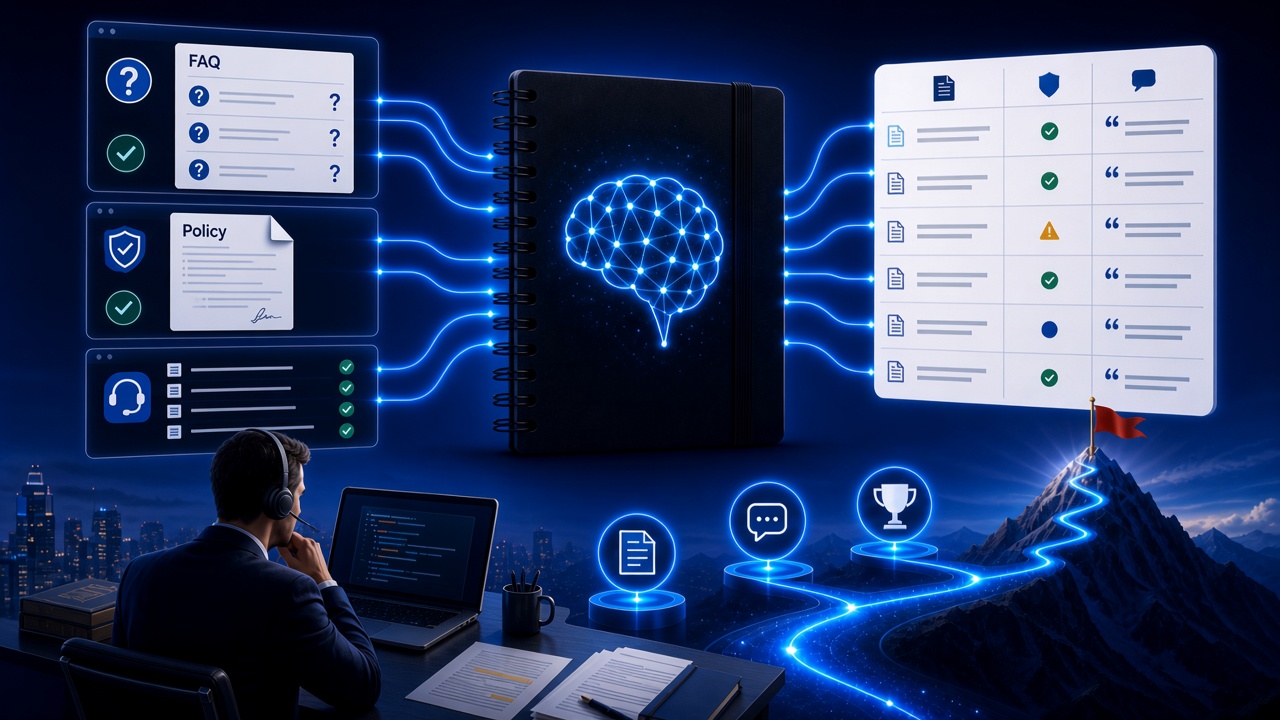
The most time-consuming part of support is often not “finding no answers,” but the help center, return policy, membership rules, version notices, and ticket comments scattered everywhere: the same rule is worded inconsistently across an old PDF, the public FAQ, and an internal wiki, so at peak shift you can only stitch scripts from memory. Put the help docs, policy PDFs, announcement pages, and training videos for the same product line into NotebookLM, and Google NotebookLM, as a source-grounded AI note-taking tool, can do Q&A from your uploaded sources—rule comparisons, version conflicts, and uncovered gaps all come with clickable citations, turning replies from “aligning by spoken impression” into “support notes with an evidence chain.”
This article systematically covers how to build a product-line/scenario notebook in NotebookLM, generate a verifiable FAQ skeleton, who it fits, and anti-hallucination tips—helping support, operations, and knowledge managers embed an AI research assistant into a real reply workflow. It also fits people searching “NotebookLM PDF,” “NotebookLM knowledge base,” or “how to use NotebookLM”: long help-center and policy PDFs are the most common entry to this source-grounded Q&A.
Why Is a Support Knowledge Base Better with NotebookLM Than Generic AI Alone?
Generic models can write fluent “agent voice,” yet often invent non-existent refund windows, mix up plan names, or even paste another region’s policy; NotebookLM’s advantages are:
- Rules can return to sources: Deadlines, eligibility, exceptions, and escalation paths have clickable citations back to a help-center paragraph or policy page
- Materials can share one library: FAQ, policy PDFs, announcement pages, and training YouTube for the same product line are managed together (see multi-source management)
- Structures are reusable: Study Guides, mind maps, and briefings can iterate on the same scenario instead of pasting from scratch in a new chat every time
- Boundaries can be declared: Require “if sources do not mention it, say so,” reducing spoken habit written as “policy already specifies”
Especially important for auditable QA sampling, cross-shift handoff, and public wording. For how NotebookLM and ChatGPT split work, see the NotebookLM vs ChatGPT guide: lock the file layer first, then the expression layer. For product docs use the product docs guide; for contracts use the legal contract guide; do not mix the three in one notebook.
How Do You Complete Evidence-Based Support FAQ Q&A with NotebookLM?
Step 1: Build a knowledge-base notebook by product line or high-frequency scenario
- Sign in to the NotebookLM app
- Create a notebook by product line or high-frequency scenario (e.g., “Returns · 2026Q3 wording”), include only sources directly related to that scenario, and do not dump a year’s tickets into one notebook
- Upload help-center and policy PDFs, announcement pages, and training recordings or QA notes (see YouTube learning, meeting capture)
Tip: One notebook maps to one scenario slice or one policy version (for example, only checking “cross-border returns and shipping”); dumping ten unrelated lines of business dilutes the precision of “what this policy actually says.” Make sure you have the right to use those texts, and follow your organization’s confidentiality and customer-data rules.
Step 2: Use questions and Studio to generate a verifiable FAQ skeleton
- “Based only on the sources, output: Question type | Original excerpt | Chapter/version | Items sources do not cover”
- “Generate a comparison table: What the help center says | What the policy PDF says | What the internal wiki says | Whether they conflict”
- “List three items among deadlines, eligibility, and exceptions that conflict or are entirely unstated, and label them separately”
Prompt patterns are in the quality prompting guide; when the scenario structure is unclear, first use a mind map or Study Guide to clarify modules. When you need external scripts, human-polish the already-checked outline; writing patterns can follow the content writing guide.
Step 3: Spot-check citations, export a briefing, and share with the support group
- Before writing QA standards or citing externally, verify key deadlines, amounts, eligibility, and versions—always open citations in NotebookLM to confirm (see source-grounded AI explained)
- When syncing with the team, generate a briefing and export; for co-reviewing the same scenario, share the notebook
- When materials are long, use an Audio Overview to hear the policy landscape first, then return to contested passages and reread the original text
Formal payouts, exception approvals, and public notices remain operations and compliance owners’ call; NotebookLM nails down “what the files actually wrote” and does not replace the ticketing system, permission approval, or human judgment.
Who Benefits Most from NotebookLM for Support Knowledge Bases and FAQ Q&A?
Frontline agents and shift leads
Turn the help center, policies, and script drafts into a Q&A-ready reply pack; before a shift, locate chapters with questions instead of flipping dozens of PDF pages at the last minute; similar-rule comparison can also follow the competitive analysis guide.
Knowledge management, operations, and QA
Cross-check multiple policies, notices, and training materials, then produce a conflict list—suited to internally unifying “which line is current”; long help-center reading is closer to the book notes guide; for academic piles use the literature review guide.
New-hire training and cross-shift handoff
Put required policies and FAQs in the same notebook; generate a rules glossary and a list of easy-to-mix deadlines; handoff materials can also follow the onboarding guide; for a test-like internal quiz rhythm see the exam prep guide.
7 Tips to Improve NotebookLM Support Knowledge-Base Results
- One scenario, one notebook (or one policy version, one notebook): Separate notebooks by product line so questions do not spill into another refund window.
- Current policy before ticket excerpts: Anchor the citable live help center/policy PDF first, then upload ticket comments and huddle notes, and require distinguishing “policy original” from “verbal exceptions.”
- Force-label uncovered items: Require listing cross-border, membership tiers, and force majeure that “materials never stipulate,” avoiding habit written as if already in policy.
- Put version and region in the notebook name: Put product line, effective date, and region (e.g., China site / SEA site, 2026-09) in the title.
- Split customer personal data: Order IDs, contact details, and payment proofs do not belong in a widely shareable notebook; permissions follow least privilege.
- You set the FAQ outline: Let AI fill excerpts and comparison tables; do not let AI invent structures the originals never had, such as “ten must-refund principles.”
- Use Gemini 3.5 well: Very long help-center PDFs and multi-notice synthesis are more stable (see Gemini 3.5 upgrade explained).
NotebookLM Support Knowledge Base vs Generic AI vs Help-Center Search Alone: How to Choose?
| Scenario | Recommended approach | Why |
|---|---|---|
| Must be based on specified policies/FAQs with auditable excerpts | NotebookLM source-grounded knowledge-base flow | Citations are traceable; fits QA, co-review, and spot-checks |
| Calming scripts or empathy drafts with no materials | Generic AI | Not bound by sources; fits divergent thinking |
| You only need to open one known help-center link | Search / open the page directly | No need to build a notebook first |
| The same scenario’s PDFs must be queried repeatedly by many people | NotebookLM sharing + briefing | Materials stay unified; fewer conflicting “word-of-mouth editions” |
NotebookLM does not “automatically close tickets and pay out”; it lets support notes stand on verifiable policy. It is Google’s AI research assistant, used to cut long-PDF misquotation and mixed definitions—not to replace operations decisions.
Synergy with Other NotebookLM Features
The support knowledge-base flow chains capabilities:
- Multi-source / YouTube / meeting notes: Input the help center, training videos, and huddles
- Quality prompting / mind maps / Study Guide: Dig scenario modules and a rules glossary
- Audio Overview: Build the policy landscape on a commute, then go back and open citations
- Briefing export / sharing & collaboration: QA pre-reads and cross-shift co-review
- Content writing / literature and book-note patterns: Switch narrative for public help-center rewrites or deep explainers
- Gemini 3.5: Improve long-PDF and multi-version synthesis quality
FAQ
Q: Can I upload a full help-center or policy PDF to NotebookLM for support Q&A?
A: Yes, provided you have the right to use that file and it fits confidentiality rules. After upload, split notebooks by scenario or policy version, require marking “content that does not appear in the original text,” and still spot-check citations on the generated comparison table.
Q: Will NotebookLM write verbal exceptions from tickets as “already specified in policy”?
A: It can, if ticket excerpts and the live policy sit in the same notebook and the prompt is vague. Separate source types, and require a table that distinguishes “policy original” from “verbal/ticket exceptions.”
Q: Can NotebookLM directly decide whether to refund or escalate a ticket?
A: It can generate excerpts of deadlines, eligibility, and exceptions that appear in the materials, but payouts, escalations, and public promises must be decided by authorized staff; handling methods the sources never gave should not be treated as facts.
Conclusion
NotebookLM customer-support knowledge bases and FAQ Q&A turn Google NotebookLM, the AI note-taking tool, into support’s “single-scenario knowledge hub”: policies can be deposited, notes have evidence, wording can be rechecked. Whether answering on shift, checking the help center, or preparing QA standards, it is worth using a source-grounded AI research assistant to pull collaboration from spoken impression back to evidence-driven practice.
Open the NotebookLM app now and build a knowledge-base notebook for the next high-frequency scenario; for basics, see our getting started tutorial.
Next: put this article to work
Keep the help center and policies in one notebook; confirm the rule before you reply.
This is an unofficial NotebookLM guide, not affiliated with Google. You will open the app and can sign in free with a Google account.
Related articles
NotebookLM Consulting Knowledge Base Complete Guide: Turn RFPs, Industry Reports, and Interview Notes into a Verifiable Project Desk with Source-Grounded AI
A complete guide to consulting knowledge bases with NotebookLM—from RFPs, industry reports, and interview notes to comparison tables, gap lists, and briefing exports—helping you turn long materials into citation-verifiable project notes with Google NotebookLM, the AI note-taking tool.
Read more →
NotebookLM Language Learning Complete Guide: Turn Textbooks, Subtitles, and Vocabulary Lists into a Verifiable Listen-Speak-Read-Write Desk with Source-Grounded AI
A complete guide to language learning with NotebookLM—from textbook PDFs, subtitle scripts, and word lists to example comparisons, confusion lists, and Audio Overviews—helping you turn language materials into citation-verifiable study notes with Google NotebookLM, the AI note-taking tool.
Read more →